
A strong cybersecurity analyst CV Germany should do one thing quickly: make the security story unmistakable. German tech recruiters do not need a dense keyword dump; they need to see, at a glance, what you monitored, what you detected, what you investigated, what you escalated, and which environments or tools support that story.
That means the CV has to read like evidence, not like a general IT profile with “security” sprinkled over the top. If your background is mixed, the job is to separate supported security experience from adjacent work and to keep the most relevant role details in the foreground.
The safest way to do that is to compare your profile with one real vacancy before you rewrite anything. Start from the vacancy, tailor the profile to that brief, then inspect the finished CV before you apply. A job like that is easier to evaluate when the recruiter can see the work, the scope, and the fit without hunting for clues.
What German tech recruiters should spot immediately in a cybersecurity analyst CV
The first scan should tell a recruiter that the candidate has real security exposure, not just general infrastructure or help desk experience. Lead with a clear cybersecurity title, the most relevant recent role, and the environment the work sat in, such as SOC operations, enterprise IT, cloud, or network security. That gives the reader a frame before they reach the bullet points.
The strongest security CVs make monitoring, detection, incident response, investigation, and escalation visible without forcing the reader to infer them. If those elements are hidden inside broad language like “supported security operations,” the recruiter has to do extra work. On a fast review, that can be the difference between a useful profile and one that feels too vague to trust.
If the profile is mixed, do not bury the security thread inside generic IT wording. Put the relevant security roles first and let them carry the narrative. A recruiter should be able to answer a simple question in seconds: is this person doing or supporting security work at the right depth for the vacancy?
- Lead with the security title and the most relevant recent role.
- Make monitoring, detection, incident response, investigation, and escalation easy to spot.
- Show environment and scope so the recruiter can judge context quickly.
- Keep the security thread obvious if your background includes broader IT work.
How to present domain evidence without sounding vague
Security bullets work best when they read like specific work, not like recycled buzzwords. Translate alerts, tickets, escalations, and post-incident follow-up into concrete statements. Say what you monitored, what you triaged, what you investigated, what you contained or handed off, and what changed because of it.
A useful pattern is action plus object plus outcome. For example, you can describe reviewing endpoint alerts, validating suspicious activity, escalating confirmed incidents, or documenting follow-up steps for the next team. If you are saying you did incident response, the evidence should actually support that depth. Otherwise, keep the claim narrower and more accurate.
This is where it helps to separate supported, adjacent, and unsupported experience. Supported means you did it and can explain it. Adjacent means you touched the area but not at the same depth. Unsupported means you should leave it out. The more honest the separation, the more credible the CV stays when a recruiter reads it quickly or compares it with a job brief.
- Turn alerts, tickets, escalations, and follow-up work into concrete bullets.
- Name what you monitored, triaged, investigated, contained, or handed off.
- Use truthful outcomes instead of stretching adjacent work into full incident response.
- Keep supported, adjacent, and unsupported claims separate.
Which tools, environments, and frameworks to make explicit without overloading the CV
A security CV should list tools only when they genuinely prove the work. If you used SIEM, EDR, cloud security tools, network tooling, or a ticketing system as part of real duties, make that visible. The point is not to collect as many terms as possible; it is to show the recruiter how you operated in the role.
Frameworks and standards belong in the CV only when they are truthful and relevant to your work. If you used a process or standard in monitoring, incident handling, or documentation, say so. If not, leave it out. A focused tool list is stronger than a long inventory that sounds padded.
For context, incident handling is often explained through structured lifecycle thinking, which is why references such as the NIST Computer Security Incident Handling Guide can help readers understand the shape of the work. For role expectations in the wider labour market, the Cybersecurity Analysts page on O*NET offers a plain-language view of common duties and skills. Use those kinds of references to calibrate your wording, not to copy phrasing mechanically.
- List SIEM, EDR, cloud, network, and ticketing tools only when they are real evidence.
- Mention frameworks or standards only if you actually worked with them.
- Prefer a compact, role-relevant tool set over a keyword dump.
- Use tools to prove experience, not to pad the profile.
How to structure experience so scope, ownership, and impact are easy to assess quickly
The experience section should make the security story easy to follow. Put the most relevant roles first and keep chronology clear. A recruiter should immediately understand which position carries the strongest evidence for the vacancy and how recent that evidence is.
Each bullet should answer three questions: what did you do, what was the scope, and what can you support? That structure makes it easier to read and harder to overclaim. If you worked across multiple systems or sites, say so. If you owned a queue, handled a shift, or supported escalation paths, make that visible too.
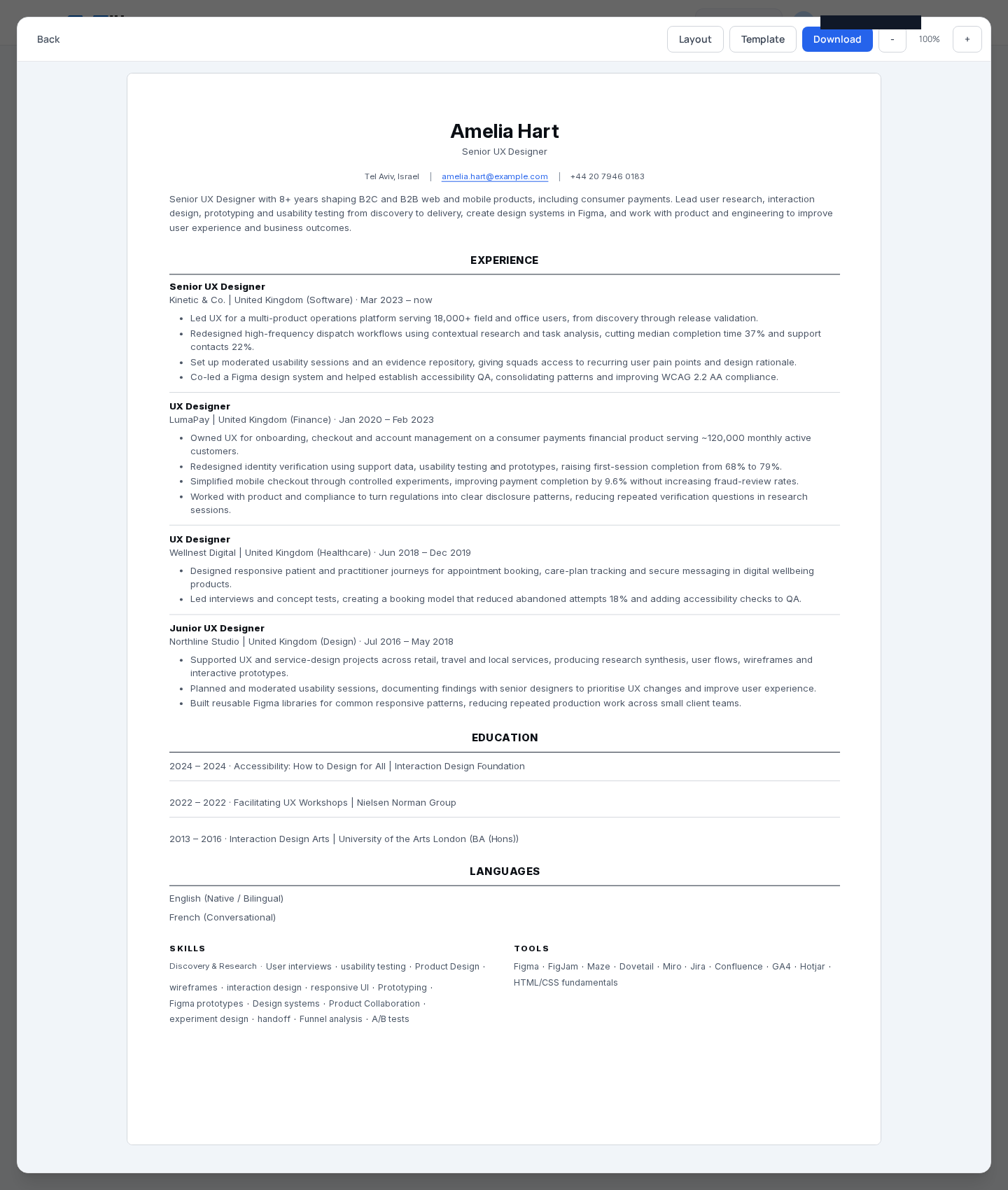
This is also where a well-structured preview matters. In CVZilla’s reusable Profile area, you keep the master version once and then tailor the role-specific version from it instead of rebuilding from scratch. The product supports the main CV inputs you actually need to shape the story: experience, projects, education, skills, tools, languages, template choice, and preview controls. What a recruiter sees before they read your bullet points is worth keeping in mind here, because the layout and ordering affect what gets noticed first.
- Put the most relevant security experience first.
- Write bullets that show action, scope, and supportable outcome.
- Keep chronology clear and avoid burying the key role.
- Use the master profile as the source, then tailor the job-specific version.
What to de-emphasize or cut when the profile is broad, mixed, or not tightly security-focused
If your background is broader than the role, be selective. Trim duties that do not support the target vacancy, even if they are true. A long list of mixed responsibilities can blur the security signal and make it harder for a recruiter to see why you fit the job.
Do not overstate on-call, investigation, or incident-response depth if the evidence is thin. German tech recruiters, like other recruiters, need a CV that can be checked quickly against the vacancy. If the experience is only adjacent, describe it that way. Honesty does not weaken the application; unsupported inflation does.
Also remove skills that are not anchored in recent work, tools, or outcomes. A profile feels stronger when every listed capability has a job, a tool, or a result behind it. That is especially important if you are trying to move from a mixed IT role into a clearer security position.
- Cut duties that do not help the target vacancy.
- Do not overstate incident-response or investigation depth.
- Remove skills that are not anchored in recent work.
- Keep one vacancy in view and avoid writing for an imaginary average role.
How CVZilla helps you compare live job results, tailor to the vacancy, and preview the finished CV before applying
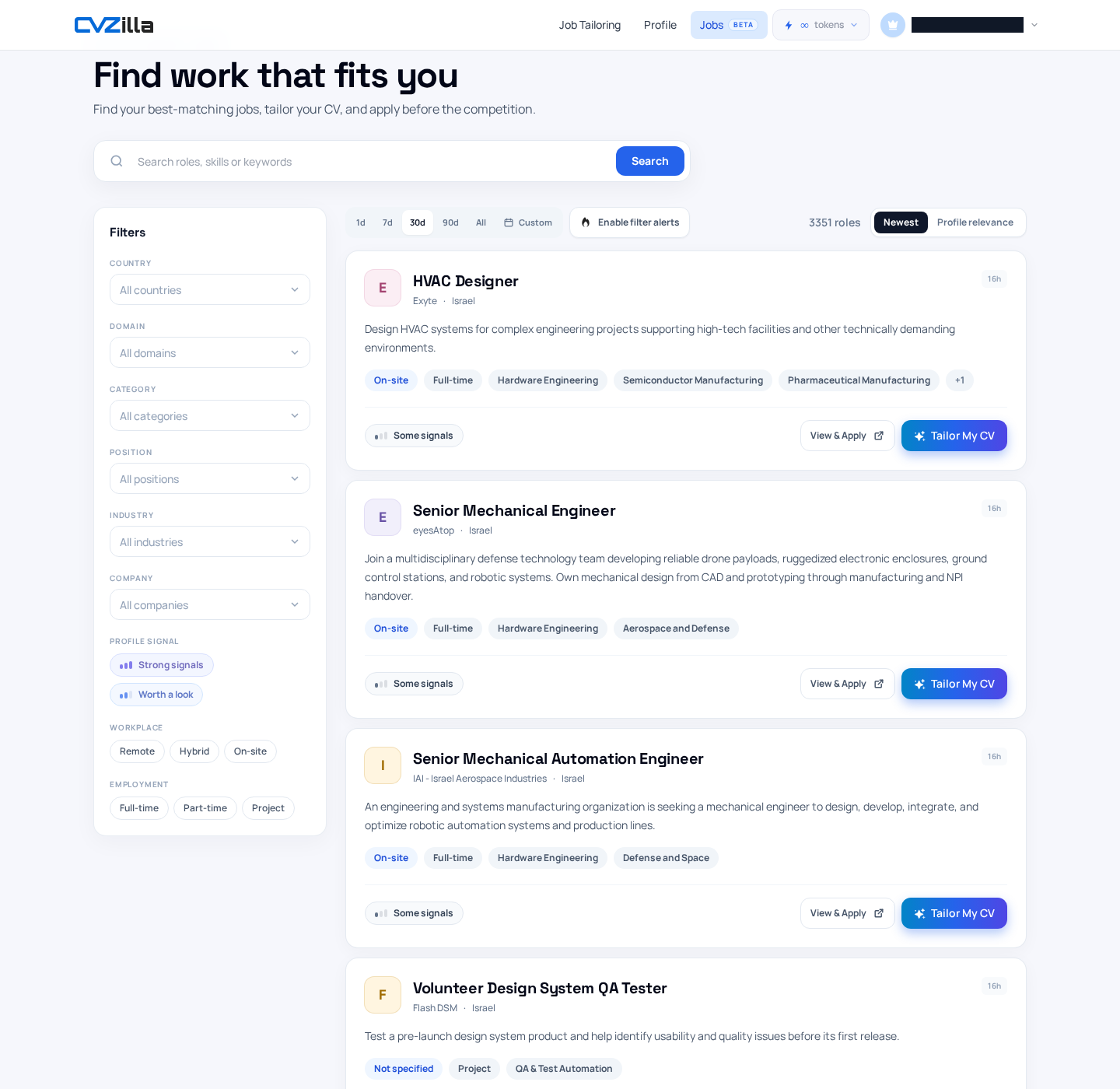
The best way to tailor a security CV is to start with one real vacancy, not a generic idea of the market. In Job results, you can browse vacancy cards and filter by country, domain, category, position, industry, company, profile signal, workplace type, employment type, and publication period. You can also sort by newest or profile relevance, which helps you compare live roles before deciding what evidence to foreground.
From there, open the original vacancy or start tailoring directly from the listing. That workflow is intentional: the vacancy is the brief. It keeps the CV anchored to the actual requirements instead of encouraging keyword stuffing. The vacancy is the brief: start tailoring from the real job explains why that matters, and the product supports it by letting you move from a live listing into Job Tailoring without losing the source role.
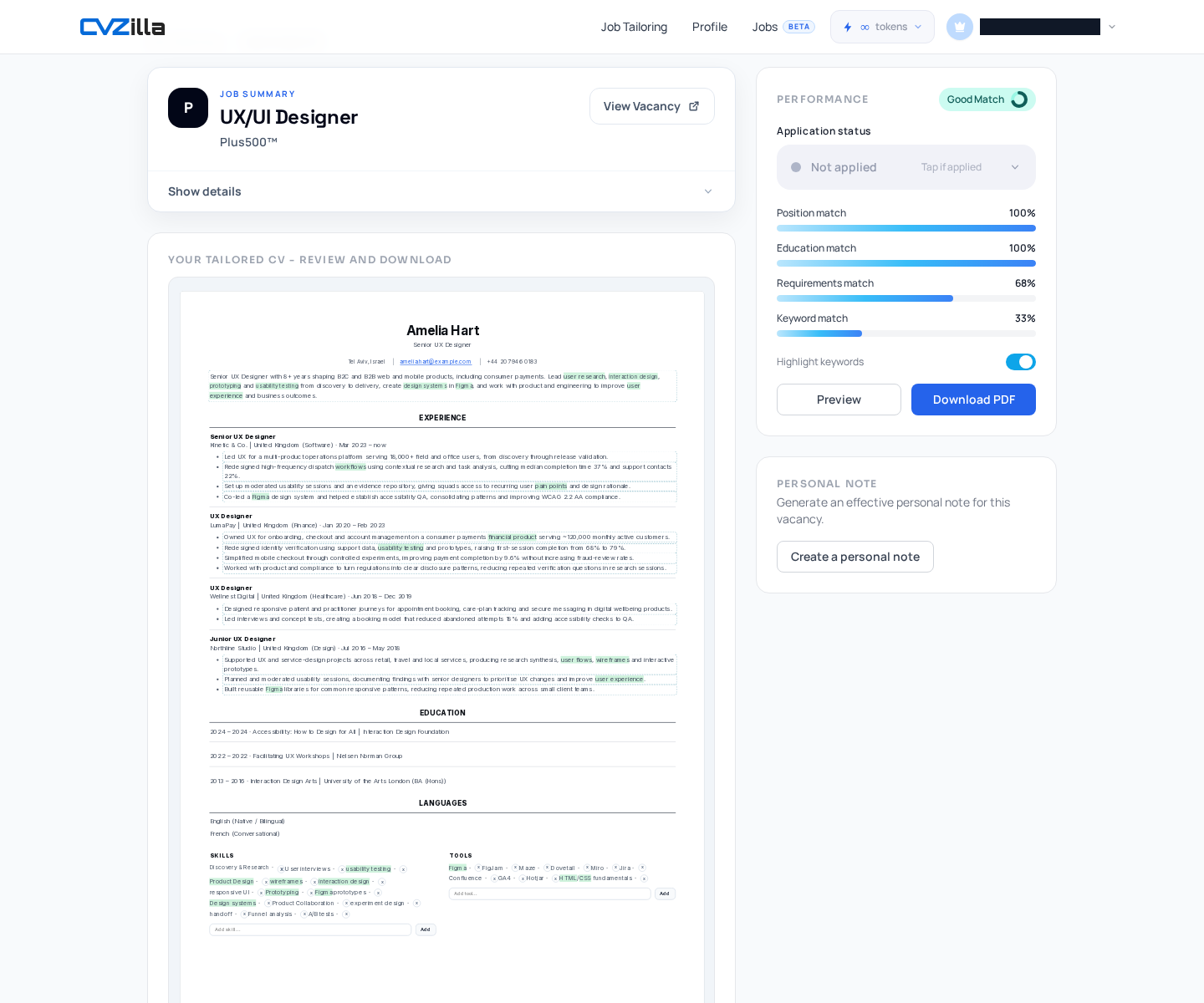
In the tailored CV workspace, look at the match signals as a sanity check, not as a substitute for judgment. The screen surfaces an overall match label and bars for role evidence, education, requirements, and keyword match. That is useful because it helps you spot weak areas before you submit. For a final check, preview the rendered CV and inspect how it reads on the page. If something looks confusing, over-claimed, or too thin, fix it before you apply. Job Tailoring is the place to do that review.
- Use Jobs to compare live vacancies before tailoring.
- Start from one real job listing so the CV reflects one real role.
- Check the match signals as a sanity check after tailoring.
- Preview the rendered CV before exporting or submitting.
A good cybersecurity analyst CV for German tech recruiters is not the longest one and not the most keyword-heavy one. It is the one that makes security evidence visible quickly, keeps the claims honest, and shows the exact work the vacancy is asking for.
If your profile is broad, that does not mean you need to hide the weaker parts. It means you need to foreground the strongest security evidence, cut the distractions, and tailor against one live role. Then preview the result and read it as a recruiter would: fast, skeptical, and looking for proof.
If you want a clean way to do that, start with live vacancies, tailor from the brief, and inspect the final CV before applying. The workflow is simple, but it protects the part that matters most: credibility.