
The easiest way to miss the point of a job search is to start from a vague idea of the role and then shape your CV around what you think that title usually means. A better method is more concrete: treat the original vacancy as the brief. It tells you what the employer is actually asking for, which requirements matter, and which details are only optional or context-setting.
That shift matters because tailoring works best when the source material is real. If you begin with the actual opening, you can keep the edit tied to one specific job instead of drifting toward assumptions, generic phrasing, or a version of the role that only exists in your head.
It also keeps the process honest. When the vacancy is the source of truth, every change has to answer a simple question: does this line help me match the opening using evidence I actually have, or am I filling gaps with guesswork? That question is what turns tailoring from decoration into a useful job-search decision.
Start with the vacancy, not a vague role
The original listing should be your source of truth for application requirements and availability. If something is not in the posting, do not assume it is required, preferred, or even relevant. That simple rule keeps role-specific CV tailoring anchored to the employer’s actual brief instead of a broader category label.
Your master profile still matters, but as a factual base rather than a source of direction. Keep the details accurate in the Profile, then let the vacancy decide which parts of your background deserve the spotlight for this application. The question changes from “what kind of person might this employer want?” to “what evidence do I already have that maps to this opening?”
Starting from the vacancy also makes your first edit more disciplined. Instead of trying to make the CV sound generally impressive, you can make it genuinely relevant. That usually means fewer speculative changes, less repetition, and a cleaner line between what you can prove and what you cannot.
That matters even more when the role title is broad or familiar, because titles can hide a lot of variation. Two jobs with the same name may differ in scope, tools, team size, or decision-making responsibility. The vacancy is where those differences show up. If you ignore it and tailor from memory, you risk polishing the wrong version of the role.
Extract the signals before you edit
Before you touch a single bullet point, read the posting for the signals that actually define the opening. Look at the responsibilities, required skills, preferred qualifications, seniority signals, tools, and domain context. Those details tell you what to foreground, what to summarize, and what to leave in the background.
If the wording feels broad, it can help to compare it with neutral occupation context in O*NET OnLine and the BLS Occupational Outlook Handbook. That gives you a wider view of how a role is usually described, but the vacancy still wins. The listing is the brief for this application; the broader references are just context.
A practical way to read the posting is to sort each signal into supported, adjacent, or unsupported. Supported means you can point to direct evidence in your profile. Adjacent means the experience is related but not identical. Unsupported means you do not have the evidence, so it should not be promoted as if you do. If you want a structured way to turn those signals into a checklist, How to Turn a Job Description Into an Application Checklist is a useful companion.
This is also where you decide how aggressive the tailoring should be. If the vacancy leans heavily on a small set of tools or a specific domain, you may need to put those facts close to the top of the CV. If the role is broader, you may need only light re-ordering and a few sharper lines. The point is not to add more content; it is to make the right content easier to see.
- Core responsibilities the employer says matter most
- Hard skills, tools, and systems that appear more than once
- Preferred qualifications that may help but are not always mandatory
- Seniority or scope signals that hint at level and ownership
- Industry or domain context that changes how experience should be framed
- Repeated outcomes, verbs, or deliverables that show what success looks like
Use CVZilla as the role-specific starting point
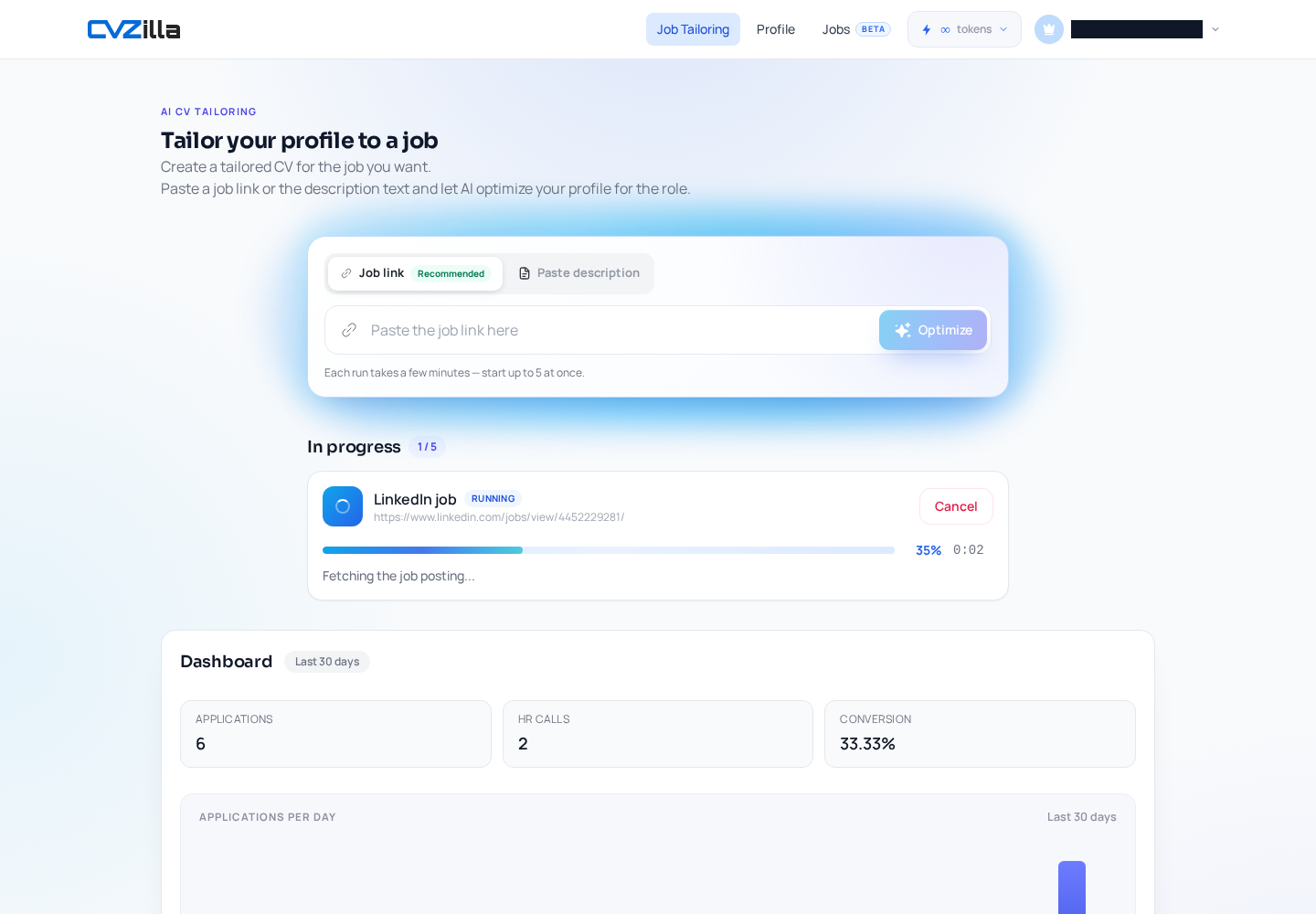
CVZilla’s Job Tailoring area is designed for a particular role and starts from the master profile as the reusable source of professional facts. That means the input is the vacancy, but the base remains your own verified career history.
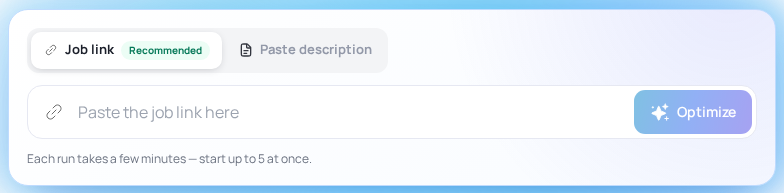
The tailoring flow supports starting from a job link or pasting a job description, so the real opening can become the input source for the work. Once you provide that vacancy, CVZilla prepares a role-focused version that you can inspect against the facts already stored in your profile. The point is to translate, not to improvise.
That distinction matters because the same person can apply to different roles without becoming a different candidate. A good tailored draft selects the evidence that belongs to this opening and leaves the rest alone. If your profile is current, the tailoring step becomes shorter, cleaner, and easier to judge.
It also gives you a better starting point for a repeatable workflow. You do not have to rebuild the CV from scratch for every application. You keep one accurate profile, feed in one real vacancy, and let the tailoring step narrow the profile toward that role. That saves time only because it reduces rethinking, not because it replaces judgment.
Review the result before you apply
Once the tailored version is in front of you, review it for accuracy, relevance, and truthfulness. If a line sounds stronger than the evidence supports, soften it or remove it. The goal is not to make the role look easier to win; it is to make your CV faithful to your actual background while still being specific to the opening.
This is where restraint matters. A vacancy may repeat a keyword, but repeating it in your CV does not make the match more real. The companion guide How to Tailor Your Resume to a Job Description Without Keyword Stuffing explains the difference between useful alignment and empty repetition.
A vacancy-first review also helps you make a better fit decision. If the role’s most important signals line up with your strongest evidence, the application is probably worth pursuing. If they do not, that mismatch is useful information too. It keeps you from applying on autopilot and helps you spend time where you are actually closer to the brief.
The review step is also where you check for any claim that moved too far during tailoring. Supported claims can stay. Adjacent claims may need clearer framing. Unsupported claims should come out. That discipline keeps the finished CV believable, and it makes your own decision clearer before you commit to an application.
Vacancy-led tailoring is simple in principle: start from the real opening, extract the signals, map them to evidence, and keep the final draft honest. When you do that, role-specific CV tailoring stops being a guessing game and becomes a focused edit with a clear purpose.
That discipline gives you two benefits at once. You send a CV that is more relevant to one specific role, and you get a cleaner answer to the deeper question of fit. If you are ready to work from the source of truth, start role-specific tailoring from the real vacancy.
The practical payoff is clarity. You spend less time polishing generic language and more time deciding whether this job actually matches what you can prove. That is a better use of effort for any application, whether you move ahead or decide not to apply.