
Tailoring a resume is not about pasting a vacancy’s language into every section. It is about making the experience you really have easier to find, understand, and connect to the role.
A strong tailored resume preserves the facts while changing the emphasis. Start with what the employer needs, find the evidence in your background, and use the most relevant language only where you can support it.
ATS-friendly does not mean copying every keyword
The common misconception is that an ATS-friendly resume must repeat every phrase in a job description. It does not. Repetition without evidence can make a resume harder for a recruiter to trust and less clear for anyone trying to understand what you actually did.
Applicant tracking systems and recruiter workflows can benefit from clear structure and role-relevant wording, but ATS behaviour varies by employer and vendor. Treat a job description as evidence about the work, not as copy to reproduce mechanically.
Use one governing rule: add a responsibility, tool, skill, or outcome only when you can back it up with real work. If your experience is comparable but not identical, describe it as transferable rather than presenting it as a direct match.
Decide whether the role is worth tailoring for first
Before changing your resume, inspect the role’s must-haves, working context, and likely gaps. Tailoring is useful when you can make relevant evidence clearer–not when it would require you to fill the page with claims you cannot defend.
Use a simple three-part lens. Supported experience is work you have done and can state directly. Adjacent experience is comparable work that may transfer, but should not be called identical. Unsupported experience is a skill, tool, credential, responsibility, or outcome you have not had, and it should not be added to your resume.
For a fuller go/no-go process, read How to Evaluate Job Fit Before You Tailor Your Resume before investing time in a role-specific version.
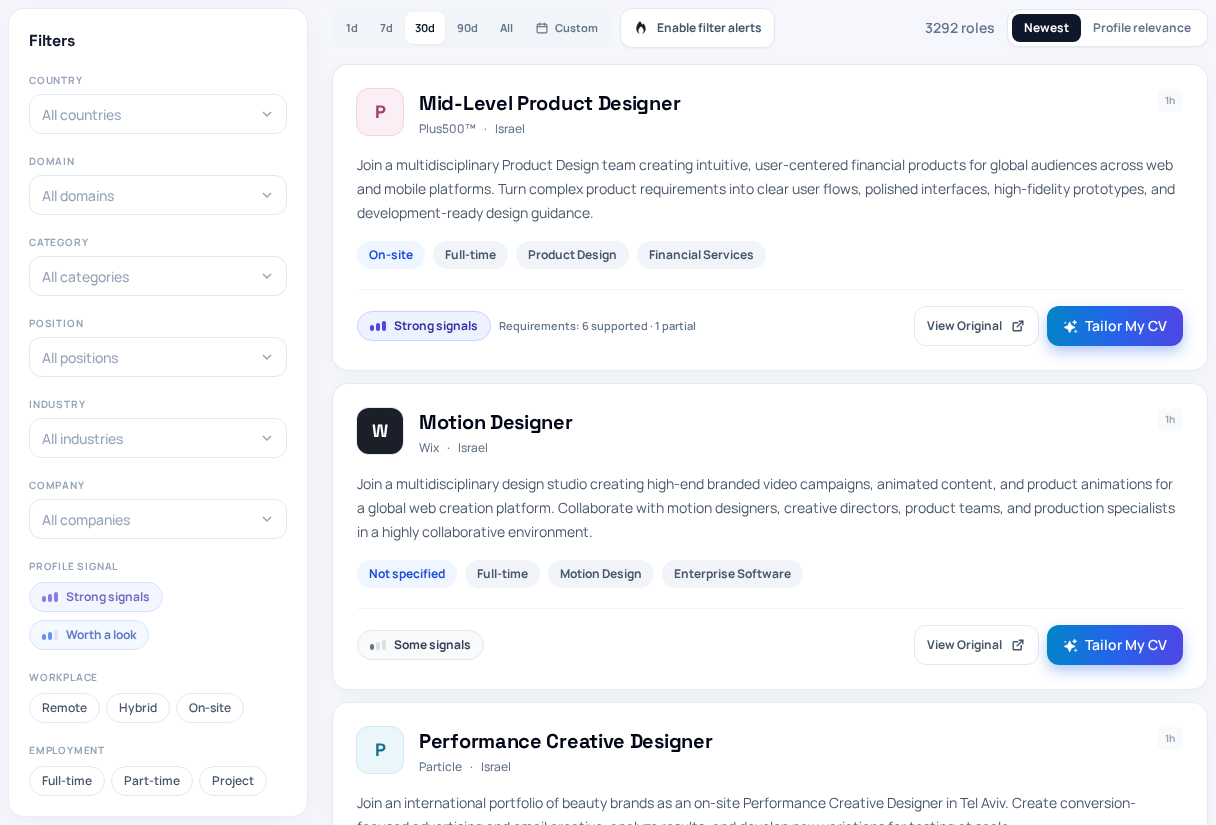
If you use CVZilla Jobs, profile signals and requirement summaries may be available to help focus your review. Explore jobs and inspect fit signals as prompts to investigate the vacancy, not as an employer assessment or a prediction of what will happen after you apply.
Break the job description into four useful buckets
Reading a vacancy as one long block of text makes every phrase look equally important. Instead, sort it into four buckets so you can see what the role actually prioritises.
Core responsibilities are the recurring work the person will own or deliver. Required skills are capabilities, tools, or credentials explicitly described as necessary. Preferred skills are advantages, not automatic proof that you need direct experience. Role context includes the industry, customer type, seniority, team environment, scale, and tools that shape how the work happens.
Mark high-signal terms as you go. Look for capabilities that repeat, appear in both the title and responsibilities, or are explicitly labelled required. These usually deserve closer attention than a one-off adjective or a long generic skills list.
- Core responsibilities: What will this person repeatedly do?
- Required skills: What does the employer explicitly say is necessary?
- Preferred skills: What would help, but is not necessarily a baseline requirement?
- Role context: In what environment, domain, level, or toolset will the work be done?
Map high-signal requirements to evidence–not aspiration
For each high-signal requirement, make a quick three-column note: the requirement, evidence from your background, and the honest resume treatment. This prevents a familiar job-description term from turning into an unsupported claim.
For a direct match, use the employer’s plain-language term when it accurately describes work you have done. For an adjacent match, lead with the comparable responsibility or outcome and retain the distinction. For example, experience reporting on campaign performance can support a claim about analysis and stakeholder reporting; it does not establish direct product analytics experience.
Leave unsupported requirements out. Do not add a platform because it appears in the vacancy, a credential because it sounds expected, or a metric you cannot verify. A maintained source of record makes this discipline much easier: Build a Professional Profile Before You Tailor Your Resume explains how to keep your work history, achievements, projects, education, skills, tools, and languages accurate before adapting their emphasis for a role.
Reframe the same accomplishment for the role
Here is a hypothetical example of truthful reframing. The accomplishment stays the same; the wording brings forward the parts that matter to the target role.
Before: “Coordinated onboarding improvements for new customers and reduced repeated support questions.”
After, for a customer-operations role: “Improved new-customer onboarding by coordinating clearer support resources, reducing repeated customer questions.”
The revised version foregrounds onboarding, customer support, and process improvement. It does not add new software, industry expertise, ownership level, metric, or responsibility. That is the difference between tailoring and embellishing.
Apply the same test to adjacent experience. A marketer who has created campaign reports can highlight analysis and stakeholder reporting for an operations role, but should not rename that work as direct product analytics if they have not performed product analytics.
Put matched language where it carries evidence
Relevant language belongs where a reader can see what supports it. Use the headline and professional summary to establish your most relevant professional theme. Use experience bullets and project descriptions for responsibilities, actions, and outcomes. Use skills and tools sections only for capabilities you have actually used.
Usually, name an important term once where it is genuinely useful, then support it with context. A bullet that says you improved onboarding by creating support resources is stronger than a resume that repeats “onboarding” in every section without showing the work.
Watch for clutter: copied multi-line skill lists, generic keyword strings, the same phrase repeated throughout the document, and tools with no evidence of use. Clear, specific writing helps both software processing and human review; repetition alone is not a reliable strategy.
Use CVZilla to tailor from an accurate source of record
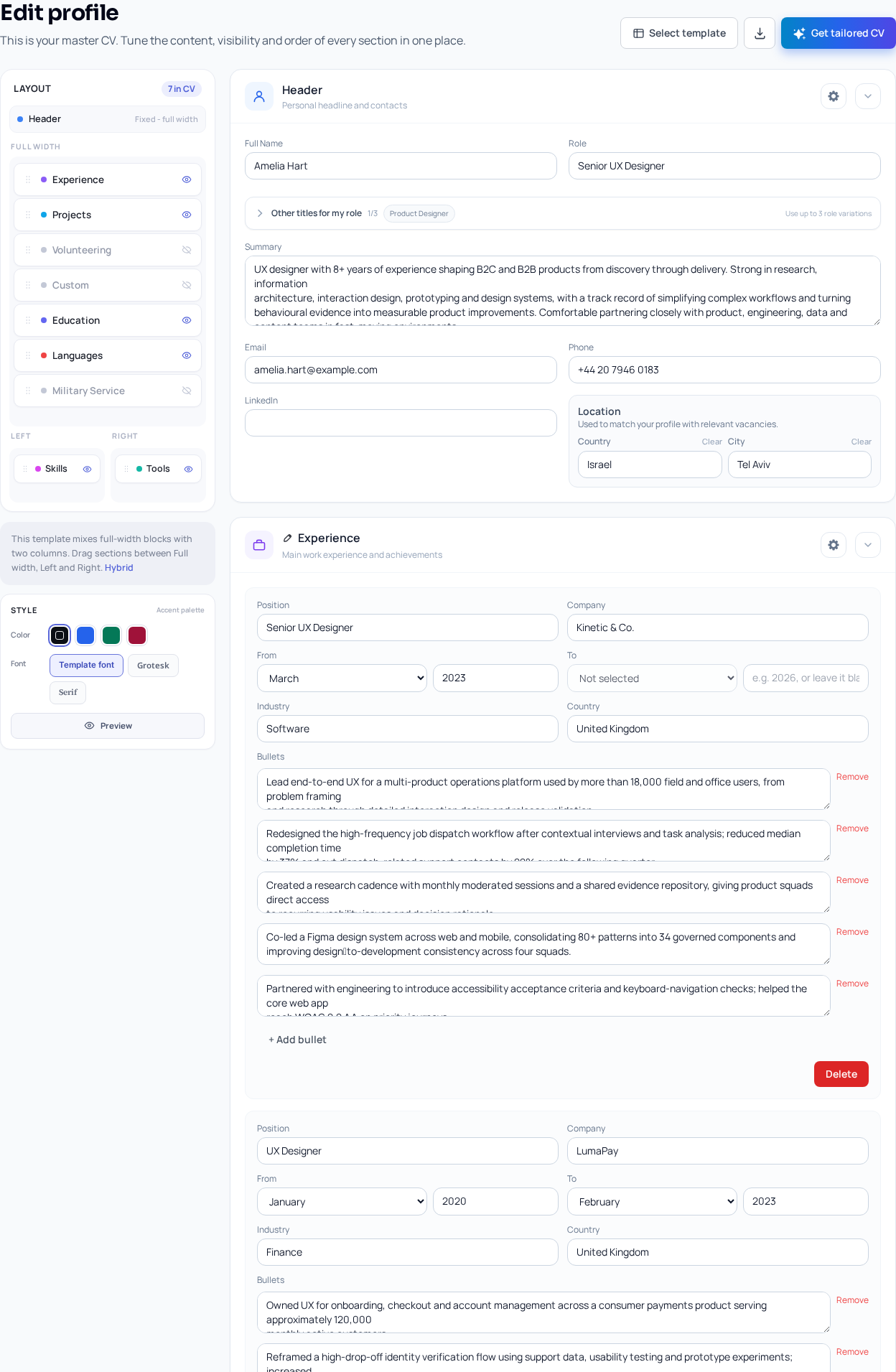
CVZilla Profile can act as your reusable master CV: a factual record of your headline, summary, experience, achievements, projects, education, skills, tools, and languages. Build or update your professional profile before starting a role-specific version, so the source material is complete and accurate.
To tailor, you can provide a job link or paste a job description, then prepare a role-focused version from your profile. Review the result for relevance and accuracy before using it in an application, and correct anything that overstates your experience.
Job details may show full, partial, or no-match requirement labels with visible evidence when available. These signals can help you decide what to inspect, but they are not a disclosed ranking formula or a guarantee of an ATS or hiring outcome.
The tailored CV editor supports inline edits to the professional summary, supported experience, project and education bullets, skills, and tools. Keyword highlighting can visually mark matching words on the CV without changing the text. Use it as a review aid–not as a reason to add language you cannot support.
Run the four-part submission check
Before you apply, read the tailored version once as a recruiter would. The goal is not maximum keyword coverage. It is a fast, credible explanation of why your proven experience is relevant to this role.
Use this final standard: tailor emphasis, not reality. A truthful, specific resume will remain useful in a recruiter conversation; a keyword-stuffed resume can fall apart as soon as someone asks for an example.
When you are ready, tailor your CV to a specific role from your accurate profile, then review every claim before you apply.
- True: Can you explain and defend every important claim, tool, responsibility, and outcome?
- Relevant: Does each highlighted capability connect to a real priority in this vacancy?
- Specific: Does the resume show what you did, how you contributed, or what changed–not only a keyword?
- Readable: Can a recruiter understand your fit quickly without repeated phrases or an overloaded skills list?
A tailored resume should make the right evidence easier to see, not create a new version of your career. Separate direct matches from transferable ones, leave unsupported requirements out, and make every important term earn its place with a real example.
No resume format or keyword strategy can guarantee an ATS result, recruiter response, interview, or job. What you can control is whether your application is accurate, relevant, specific, and easy to understand.