
If you are writing a devops engineer cv israel recruiters can actually scan quickly, the main job is not to list every tool you have touched. It is to make production ownership, cloud depth, and automation impossible to miss.
Israeli high-tech vacancies for DevOps roles often signal the same core expectations: environments you can operate, releases you can protect, incidents you can handle, and systems you can improve. That is why a strong CV should read like evidence of real operational responsibility, not generic IT support with a few cloud keywords.
This guide shows how to position the headline, summary, experience, skills, and supporting sections so the CV matches the way Israeli recruiters tend to screen DevOps candidates. It also shows what early-career candidates can use instead of pretending to have senior production ownership.
What Israeli recruiters often screen for in a DevOps CV
Recent Israeli DevOps vacancies repeatedly foreground production or staging ownership, incident response, root-cause analysis, high-availability work, cloud platforms, Kubernetes, CI/CD, and infrastructure as code. That pattern matters because it tells you what the recruiter wants to notice first: operational responsibility, not a generic technology list.
In practice, that means your CV should answer four questions fast. Which environments did you own? What did you automate? How did you protect releases? And how did your work improve reliability or response time? If those answers are buried too far down, the best signals are effectively lost.
If you do not have direct production ownership yet, use adjacent evidence honestly. A lab deployment, capstone project, military infrastructure work, or academic automation project can still show cloud, CI/CD, and operations readiness. The caveat is important: do not inflate that work into senior production responsibility, because the mismatch becomes obvious once the vacancy is compared with the CV.
Write a headline and summary that read as DevOps work
Your headline should match the role family the vacancy is actually advertising. DevOps Engineer, Platform Engineer, and Infrastructure Engineer all signal production-facing work more clearly than a vague title like IT Specialist. That framing is supported by role taxonomies and Israeli training guidance that place DevOps close to software, systems, cloud, and automation rather than office support.
The summary should be short and specific. State the environment, the scope, and the value in one or two lines: cloud and Kubernetes, CI/CD and IaC, observability and incident support, production reliability. That wording helps a recruiter understand the shape of your work before they study the bullets. If you are early career, say what you built or operated in projects instead of implying full production seniority.
Avoid summaries that sound like helpdesk, desktop support, or broad IT administration. Those cues can pull attention away from the engineering side of the role. At the same time, if the vacancy is actually hybrid or support-heavy, the wording should still match the job instead of forcing a DevOps label onto the wrong target.
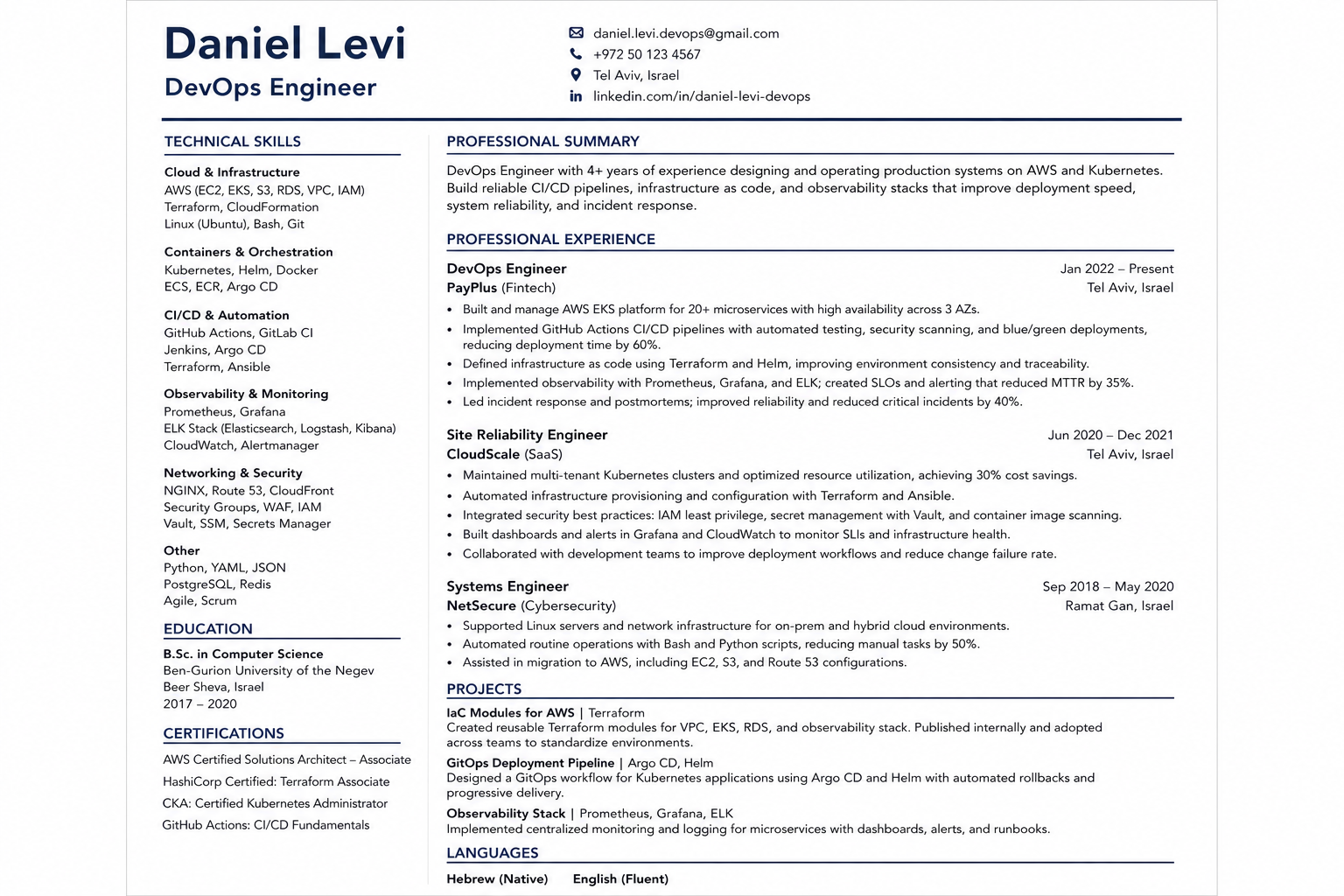
Rebuild experience bullets around production outcomes
Experience bullets are where many DevOps CVs lose credibility. A task list that says you “worked with AWS, Kubernetes, and Jenkins” is not enough on its own, because it proves familiarity but not ownership. A stronger bullet identifies the system, the action, and the result: automated infrastructure provisioning, standardized deployments, improved monitoring, or supported incident recovery.
Use the recurring signals from Israeli postings as your organizing frame: cloud platform work, container or Kubernetes operations, CI/CD, infrastructure as code, observability, scripting, and incident response. Four bullets that show depth are usually better than ten bullets that repeat tools without context. If you have a real metric, use it. If you do not, describe the operational change accurately rather than inventing numbers.
The main failure mode here is keyword dumping. Recruiters can usually tell when a bullet was built to satisfy an ATS rather than to describe real work. A bullet should make it easy to see what you owned, what changed, and why it mattered in production.
Organize skills so they show applied depth, not a random stack dump
For Israeli DevOps roles, the skills section works best when it is grouped by use case. Cloud or platform, orchestration, release automation, observability, scripting, operating systems and networking, and security basics are all easier to scan than one flat alphabetized list. This structure also mirrors how many vacancies describe the role.
Put the most credible and recent tools first. Separate what you used in production from what you only touched in training when that distinction matters. That is especially useful for junior candidates, because a shorter list you can defend in interview is stronger than a longer one that sounds impressive but collapses under questioning.
Do not fill space with generic office software or unrelated tools. But do not remove Linux, networking, security basics, or hybrid or on-prem exposure if the vacancy asks for them. Enterprise and public-sector environments may care as much about those foundations as they do about cloud depth.
Use projects, courses, and certifications honestly when experience is thin
Israeli CV guidance explicitly allows projects, volunteering, education, and courses to stand in when direct experience is limited. That makes a DevOps course, a homelab, a capstone project, or military and academic infrastructure work worth showing if they genuinely map to cloud, CI/CD, automation, or operations.
For each project, describe the stack and the operational lesson, not just the fact that the project exists. A useful project bullet shows the pipeline, the environment, and the control you exercised over deployment, monitoring, or rollback. “I learned DevOps” is too vague. A recruiter needs to see evidence that the work resembles the vacancy, even if it is not full production ownership yet.
Keep side work only when it is real, relevant, and defensible. A personal lab can help prove readiness, but it should not be used to fake employer-scale responsibility. The goal is not to sound senior; it is to show truthful fit for the next role.
Tailor one CV to one vacancy and avoid the common mismatches
Start from the vacancy as the brief. Mirror the role language, reorder the sections to match the advertised responsibilities, and emphasize only the tools and outcomes the employer actually named. Israeli CV guidance consistently favors tailoring to the job rather than sending a static document to every opening. For a practical way to do that, see The vacancy is the brief: start tailoring from the real job.
Before you send the CV, check the common mismatch points: a generic IT headline, a skills dump with no context, unsupported seniority claims, hiding production exposure, or omitting Linux, networking, or hybrid experience that the employer asked for. Those mismatches often weaken fit more than one missing keyword. If you want a clearer view of how layout and first impressions shape the scan, read What a recruiter sees before they read your bullet points.
A good tailing pass changes emphasis, not truth. If you need two versions, vary the ordering, the summary, and the bullet selection, but keep the facts consistent. That is also where Job Tailoring becomes useful as a working step, because the same honest profile can be adjusted to fit one vacancy without becoming a fabricated one.
A strong devops engineer cv israel recruiters will respond to is clear about role, scope, and production responsibility. It does not hide the fact that DevOps is operational work, and it does not pretend that every tool belongs in the same place.
If your experience is senior, lead with ownership and reliability. If your experience is lighter, lead with the strongest truthful evidence you have: projects, automation, cloud labs, certifications, and relevant infrastructure work. In both cases, the win is the same: the recruiter can see why your profile fits this vacancy before they have to guess.
The safest next step is to tailor one truthful CV to one job description, then keep the emphasis aligned with the actual role. If you need a vacancy-first method for that, use the linked tailoring guide as your next pass.