
German embedded teams usually scan a CV for proof, not buzzwords. They want to see whether you have real firmware scope, whether you worked close to hardware, how you debugged problems, and whether you delivered reliably in test and production-like environments.
That makes an embedded software engineer CV different from a generic software CV. If you are an expat or immigrant, the goal is not to inflate your title; it is to translate your real experience into hiring language that feels natural in Germany and stays fully truthful.
What German embedded teams are scanning for first
The first pass is usually simple: does this person look like they have actually done embedded work? For German hardware and firmware teams, the strongest signals are firmware ownership, device or board context, debugging depth, test environment exposure, and reliable delivery. Broad labels like “software engineer” matter less than the evidence behind them.
A concise, role-aligned CV helps that evidence surface quickly. Lead with the most recent firmware, systems, or device-facing work, and keep older adjacent roles lighter unless they directly support the embedded story. A reviewer should not have to decode your history to understand whether you belong in an embedded team.
- Foreground firmware scope, board or device context, and the parts of the system you actually owned.
- Keep older or adjacent software roles shorter unless they add direct evidence for embedded work.
- Do not claim a stronger embedded remit than you really had; the CV should reflect the job you actually did.
Which embedded signals belong at the top of the CV
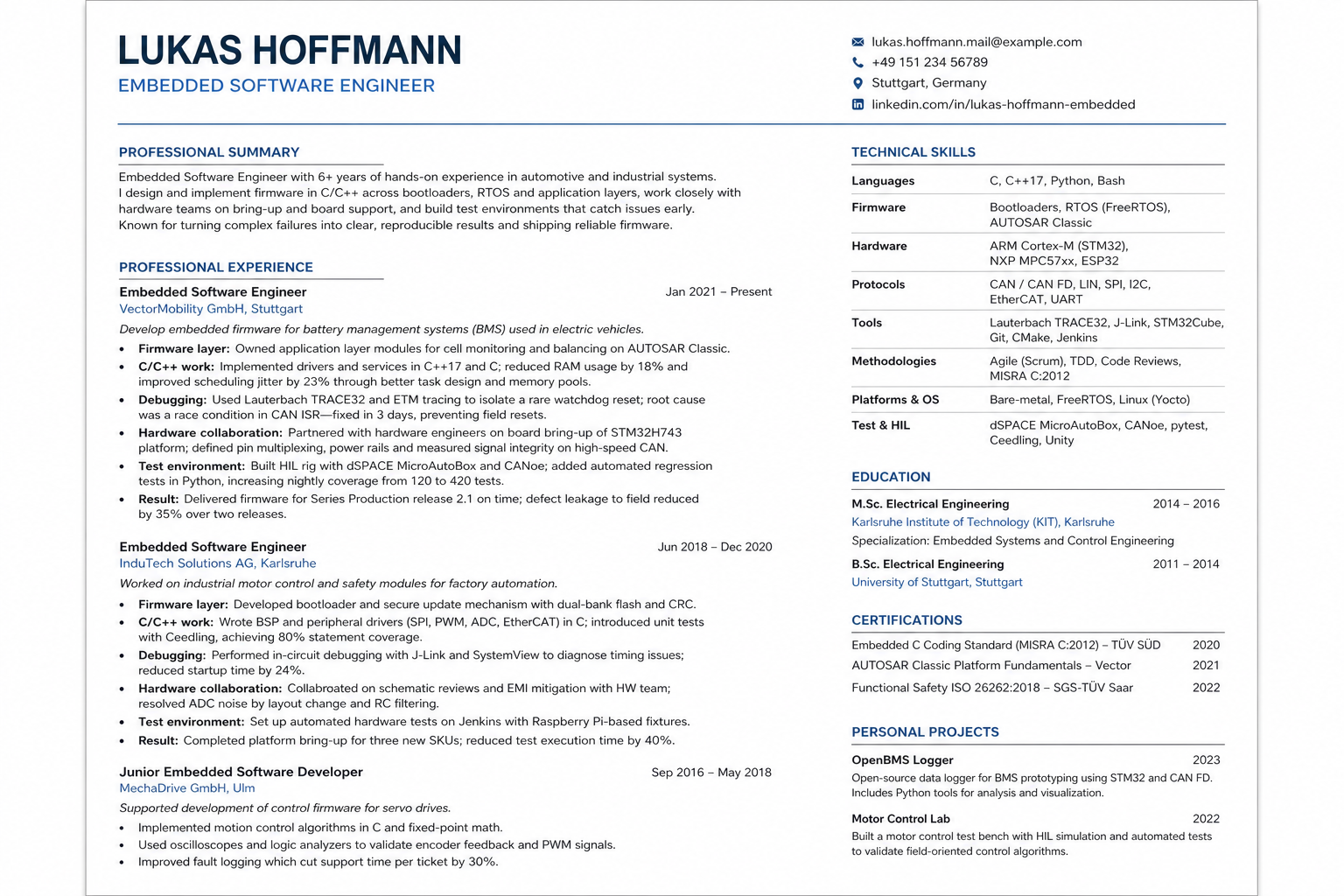
The most believable bullets are concrete. Name the firmware layer, the C or C++ work you did, the debugging method, the hardware collaboration, and the test environment. Then show the result: a defect found, a bring-up completed, a test case improved, or a failure isolated faster than before.
This is where supported, adjacent, and unsupported claims matter. Supported claims are things you truly owned. Adjacent claims sit near embedded work, such as automation or integration. Unsupported claims are the ones that sound good but overstate your role. A truthful CV separates those three layers instead of blending them into one vague paragraph.
A weak bullet says you “worked on embedded systems.” A stronger one says what subsystem you touched, what tools or lab setup you used, and what changed because of your work. That distinction matters because embedded reviewers are looking for scope, not just familiarity.
- Name the subsystem, the tools or environment, and the result delivered.
- Separate direct embedded ownership from adjacent software or integration work.
- Use precise language that proves depth instead of relying on generic labels.
How expats and immigrants should translate experience without inflating it
International candidates often have the right experience but the wrong wording. A title like “software engineer” can hide real firmware responsibility, while a stronger-sounding title can accidentally imply ownership the candidate never had. The safest approach is to translate the wording, not the substance, so the CV reads naturally to German reviewers without exaggeration.
Keep one factual master profile and adapt it to the vacancy you are targeting. Europass and other European CV guidance support the idea of a profile-based, concise, role-aligned CV, and they also store the broader information you may want to reuse across applications. For a general European structure, see Create your Europass CV.
The practical rule is easy: if the duties truly match, localize the title or bullet wording to fit the vacancy; if they do not, keep the original meaning. That is especially important when you have career gaps, mixed responsibilities, or a path that moved between hardware-adjacent and pure software roles. Honesty makes the CV easier to trust than a polished but inflated story.
- Translate titles and project wording only when the underlying duties truly match.
- Use one factual master profile as the source of truth for all versions.
- Explain gaps or shifts briefly instead of hiding them behind a stronger title.
How to turn one vacancy into a truthful checklist
A vacancy is not text to copy. It is evidence about what the team needs. Start by turning the job ad into a checklist with three buckets: direct match, adjacent support, and unsupported or omit. That keeps the CV shaped by proof rather than by keyword stuffing.
This is also where the product workflow is useful. The job detail view can show requirements grouped by full, partial, or no match with visible evidence, so you can compare your background against the role instead of guessing. If you want a broader method for doing that by hand first, How to Turn a Job Description Into an Application Checklist is a useful companion.
For embedded roles, the most useful vacancy signals are often specific: firmware stack, C or C++, debugging environment, lab or bench work, and collaboration with hardware teams. That is why the job itself should guide your priorities, not just your old CV wording. The point is to match evidence to the role, not to force every application into the same shape.
- Sort requirements into direct match, adjacent support, and omit.
- Use the vacancy to set priorities, then map each claim to proof.
- Treat missing evidence as a reason to narrow the claim, not to embellish it.
How CVZilla supports review, evidence-based editing, and preview before sending
CVZilla’s workflow follows the same logic: start from the master profile, tailor from a real vacancy, then review the result before applying. That sequence matters because it keeps the profile as the source of truth and reduces the chance that a persuasive-sounding line slips in without support. The vacancy is the brief: start tailoring from the real job covers that idea from a product angle.
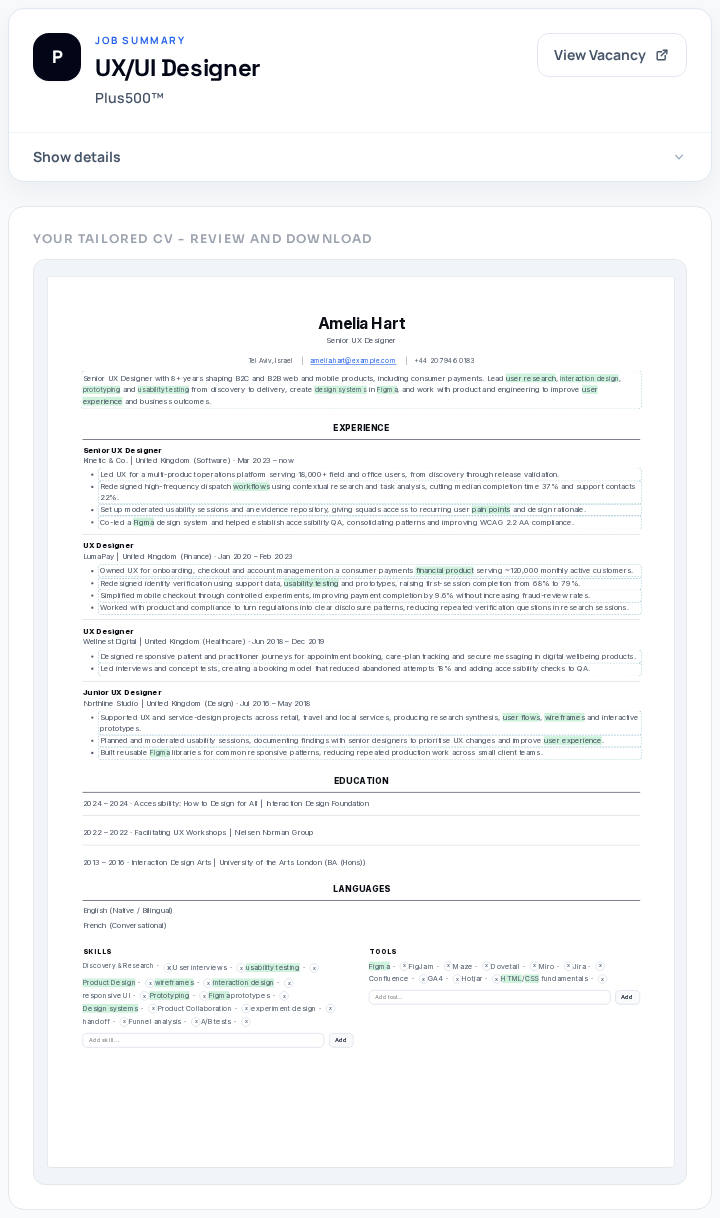
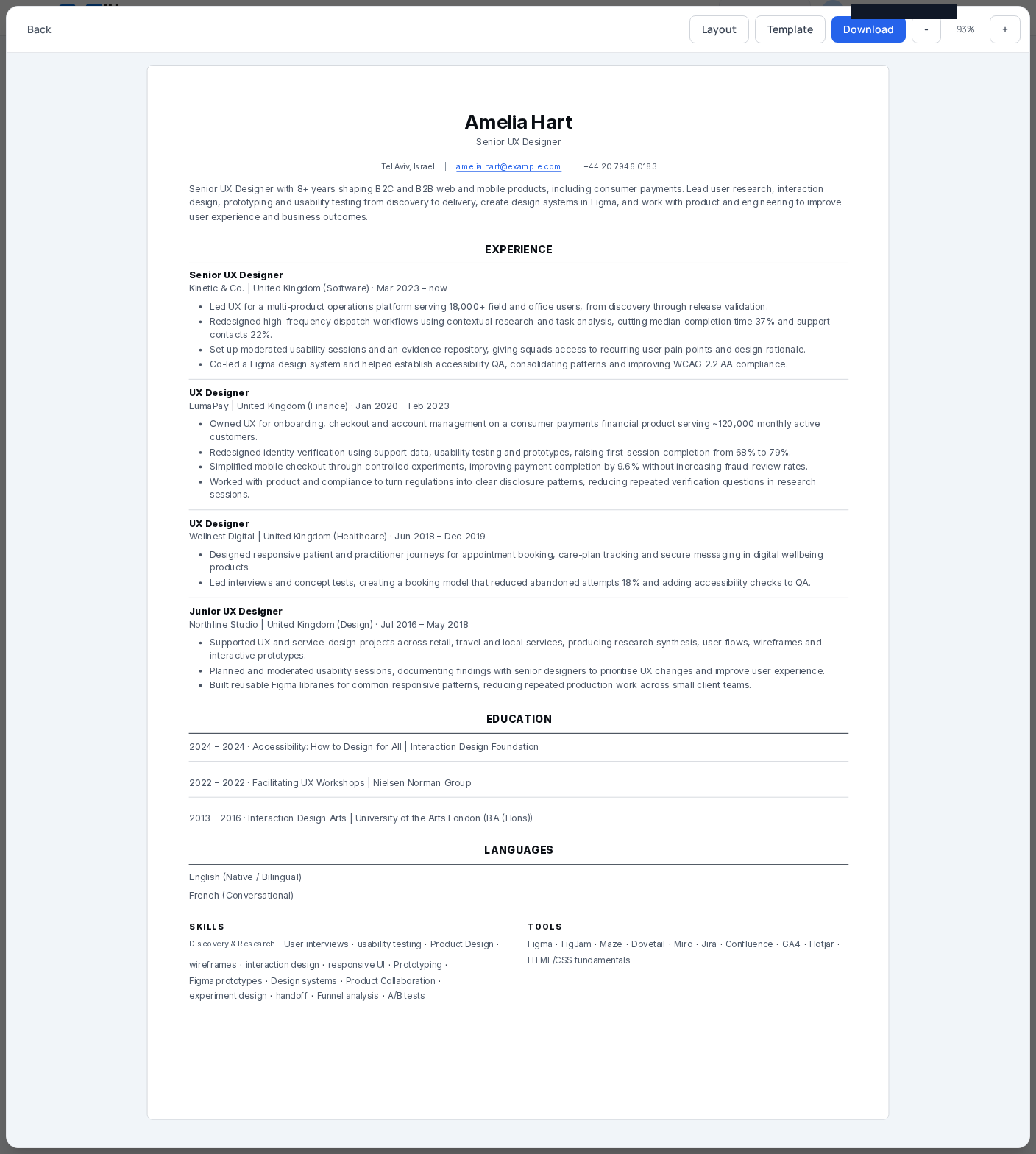
The tailored editor supports review, inline editing, preview, template and layout controls, and PDF download. That means you can check whether the final CV actually reads like an embedded CV, not just whether the wording sounds attractive. For a related example of why preview matters, Previewing Before Export Is the Simplest Way to Catch Layout Problems shows the value of checking structure before sending.
The public Jobs area is a starting point for discovering and opening vacancies, not an exhaustive database. That is a useful limitation to keep in mind: even when the system helps surface a role, you still need to verify the vacancy, match evidence honestly, and decide whether the final version is accurate enough to send.
- Use the master profile as the factual base, then tailor from a real vacancy.
- Review structure and presentation in preview before exporting or sending.
- Treat job discovery as a starting point and verify the final application yourself.
For German embedded teams, the strongest CV is the one that makes real engineering work easy to spot. Firmware scope, C and C++ work, debugging depth, hardware collaboration, test environments, and reliable delivery should be visible without exaggeration.
If you are moving between countries, use the vacancy as your guide, translate your experience into natural hiring language, and keep a clean line between supported and unsupported claims. That is the simplest way to make an embedded software engineer CV read credibly in a German hiring context.