If you are applying for data engineering roles in the Netherlands, your CV needs to do one thing fast: make the engineering evidence easy to trust. Dutch hiring teams are usually scanning for systems, scope, and relevance, not long career narratives.
That means a strong data engineer CV Netherlands version should foreground the work that proves you can move, transform, validate, and serve data reliably. The best version is compact, factual, and anchored to a real vacancy rather than a generic international template.
This guide shows what to surface first, what to trim back, and how to use CVZilla to start from one truthful master profile, compare it with one real vacancy, and review the tailored result before you send it.
Lead with the signals Dutch hiring teams scan first
Start with the experience that most clearly proves your engineering value: pipelines, orchestration, data quality, warehousing, cloud, and tooling. Those are the signals that help a reviewer understand what you actually built and maintained, instead of making them infer it from a broad job title.
Keep the top of the CV easy to scan. A hiring manager should be able to see your core stack, the kinds of systems you worked on, and the kind of outcomes you supported within a few seconds, especially when they are comparing many technically similar applicants.
Use the vacancy as the reference point, not a generic international template. If the role emphasizes batch pipelines, dbt, Airflow, Snowflake, or cloud observability, your CV should make it obvious whether you have direct, adjacent, or unsupported experience in those areas. For a broader explanation of why the real job should shape the document, see The vacancy is the brief: start tailoring from the real job.
A useful rule is to lead with evidence that is easy to verify. If you designed ingestion jobs, say so. If you improved data checks before reporting, say that too. If you only supported a pipeline incident occasionally, that belongs lower than work you owned end to end. This is where a Netherlands-focused CV differs from a generic international one: it is not trying to sound broad, it is trying to read as relevant within seconds.
- Foreground direct experience with pipelines, orchestration, warehousing, cloud platforms, and data quality work.
- Make the most relevant systems and tools visible early, not buried in a long summary.
- Treat the vacancy as the brief and avoid writing for an imagined “ideal” employer.
Show scope and impact without inflating the story
Good CV bullets for data engineering are specific, not dramatic. Describe the systems you touched, the data you owned, the tools you used, and the reliability or delivery work you actually performed. That gives Dutch hiring teams useful detail without forcing them to decode vague claims like “improved platform performance.”
A truthful bullet often has three parts: what you worked on, what was in scope, and what changed. For example, a pipeline bullet might mention the dataset, orchestration tool, cloud service, and the operational result you can verify. If you do not have a verified number, do not manufacture one just to make the line feel stronger.
It also helps to separate supported experience from adjacent experience and unsupported claims. Supported means you did the work yourself. Adjacent means you were near it, contributed to it, or learned it enough to mention carefully. Unsupported means you cannot defend it in an interview, so it should stay off the page. That discipline matters more than keyword density, and it keeps your CV credible.
If you are unsure whether a line is strong enough, ask a simple question: could I explain this clearly to a hiring manager in a short conversation? If the answer is yes, the line probably belongs. If the answer depends on stretching your involvement, the CV is better without it. For a role like this, clarity beats decoration every time. A straightforward bullet about a warehouse migration, a daily orchestration flow, or a data quality rule is more useful than a broad statement about “driving insights.”
When you need a framing reference for occupations and responsibilities, independent occupational resources can help you think in concrete duties rather than buzzwords. The O*NET summary for database administration and architecture is a useful example of that style of plain-language role definition.
The O*NET summary for database administration and architecture is a useful example of that style of plain-language role definition.
It is not a template for your CV, but it can help you keep descriptions grounded in actual work.
- Describe systems, datasets, batch or streaming jobs, ownership boundaries, and reliability work you actually did.
- Use numbers only when they are real and verifiable.
- Separate supported, adjacent, and unsupported claims before they go onto the CV.
Use the master profile as your factual source
The cleanest way to keep your CV honest is to build one master profile first. In CVZilla, the Profile area is your reusable source for experience, projects, education, skills, tools, languages, and layout choices, so you can keep the facts in one place and tailor from there instead of rewriting from memory each time.
That matters for expats because it reduces drift. A single accurate profile makes it easier to decide what belongs in a Netherlands application and what should stay in the background. It also makes it easier to maintain consistency across applications, which is important when your work history spans different markets or job titles.
If you want the base document to stay useful, make it detailed but controlled. Include enough evidence to support tailoring, but keep it factual. That way the same profile can feed many applications without becoming bloated or turning into a generic skills dump. The Profile area is designed to act as that source of truth.
A practical way to think about the profile is this: it is where you collect every defensible fact, while the final CV is where you select the best facts for one role. That distinction helps you avoid the common expat mistake of compressing too much international experience into a thin summary that leaves the reader guessing. A stronger master profile gives you room to choose later without inventing anything now.
If you want a wider view of how one source document can support a tailored application, the article Profile on CVZilla is the right place to start.
- Build one master profile with experience, projects, education, skills, tools, and languages.
- Keep the base profile factual so it can support many applications.
- Use the profile as the source of truth before tailoring to a specific role.
Tailor against one real vacancy, then review before you send
Once the profile is in place, use one real vacancy as the brief. The Jobs area lets you browse openings and open the original listing, and the job detail view can show the responsibilities, requirements, nice-to-have items, benefits, and relevance labels that help you decide whether the role is a fit. The original vacancy source is the authoritative reference for what the employer actually asked for.
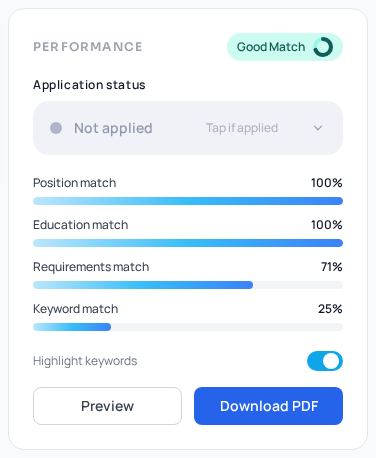
That is why tailoring works best when you move from the vacancy into Job Tailoring rather than guessing what the employer wants. CVZilla is built to start from your master profile and one specific role, then help you review the tailored result for accuracy and relevance before you apply. The fit signals, preview, and PDF download make it easier to inspect what changed and whether the final CV still tells the truth.
If you want a practical workflow, start by reviewing the vacancy first, then decide what to promote, what to soften, and what to leave out. You can compare the source job against your profile in Jobs, prepare the application in Job Tailoring, and keep your master details current in Profile. If you want a deeper walkthrough of the vacancy-first method, the guide on The vacancy is the brief: start tailoring from the real job is a useful companion.
The point is not to chase a perfect score or to force every keyword onto the page. The point is to make a document that matches the work the employer is trying to fill. When the vacancy says it needs orchestration, transformation, cloud warehouse work, or governance-minded data quality, your tailored CV should show the closest truthful proof you have. If a requirement is only adjacent, you can still acknowledge it, but you should not promote it as if it were your core experience.
That final review step matters because a tailored CV can still go wrong if the source profile was too broad or if a bullet was moved without enough context. Before sending, check whether the facts still line up, whether the role-specific emphasis makes sense, and whether anything important was lost in the tailoring. The aim is a clear application you can stand behind.
- Open the vacancy details and original source before tailoring.
- Use the fit signals and preview to check whether the tailored CV still matches the role.
- Review the result for accuracy and relevance before sending it.
A strong data engineer CV for the Netherlands is not a louder CV. It is a clearer one. The best version surfaces the engineering evidence a reviewer can scan quickly, describes scope and impact truthfully, and leaves out claims you cannot defend.
If your current CV is too broad, start with one master profile, one real vacancy, and one careful review of the tailored result. That sequence keeps the application grounded in facts and gives you a more practical path to a role that fits your experience. If you want to keep the process focused, the Jobs area, Profile area, and Job Tailoring workflow give you a simple way to move from source material to a reviewed application without guesswork.