If your career is built on contracts, side projects, internal launches, or client delivery, a standard employer-by-employer CV can hide the best evidence. In high-tech, hiring teams often want to see what you built, shipped, fixed, or improved.
A dedicated project section gives that work its own place in the project experience CV, so chronology stays readable and outcomes do not disappear inside one generic role history. That matters even more for olim and expats, whose work may cross countries, gaps, and different work modes.
CVZilla’s Profile is designed as a master source for that factual base, which makes it easier to keep project and work history current before tailoring to a real vacancy.
Why project-heavy candidates need a dedicated place for project experience
When the work itself is project-shaped, the CV should be too. A contract engagement, a side build, a delivery assignment, or an internal initiative usually has its own dates, scope, and result. If you squeeze all of that into one employer entry, the reader has to reconstruct the timeline.
A separate project record makes the evidence easier to scan and reuse. That is the point of keeping a master source in CVZilla’s Profile: one maintained profile can hold the facts once, then support later tailoring without forcing you to rebuild from memory.
Project work is not second-tier clutter. In a project-heavy career, it is often the clearest proof of capability. The caveat is simple: separation only helps when the entry stays specific and honest.
What belongs there, and what should stay in employer history
Use the project section for work with a distinct purpose, contribution, or outcome. That usually includes side projects, contract roles, delivery work, internal initiatives, and client-facing assignments.
What should stay elsewhere? Routine duties that do not have a separate project context, or work that would only be renamed to look more impressive. If your contribution is adjacent rather than direct, say so.
Relevance beats volume. A project belongs when it helps prove capability for the target role. The vacancy is the brief, so tailoring should start from the real job rather than from a pile of keywords. Do not create a project entry just to restyle ordinary employment history. For a recruiter’s first scan, the order and clarity of the evidence matter as much as the wording, which is why What a Recruiter Sees Before They Read Your Bullet Points is a useful lens here.
How to record each project so it stays reusable later
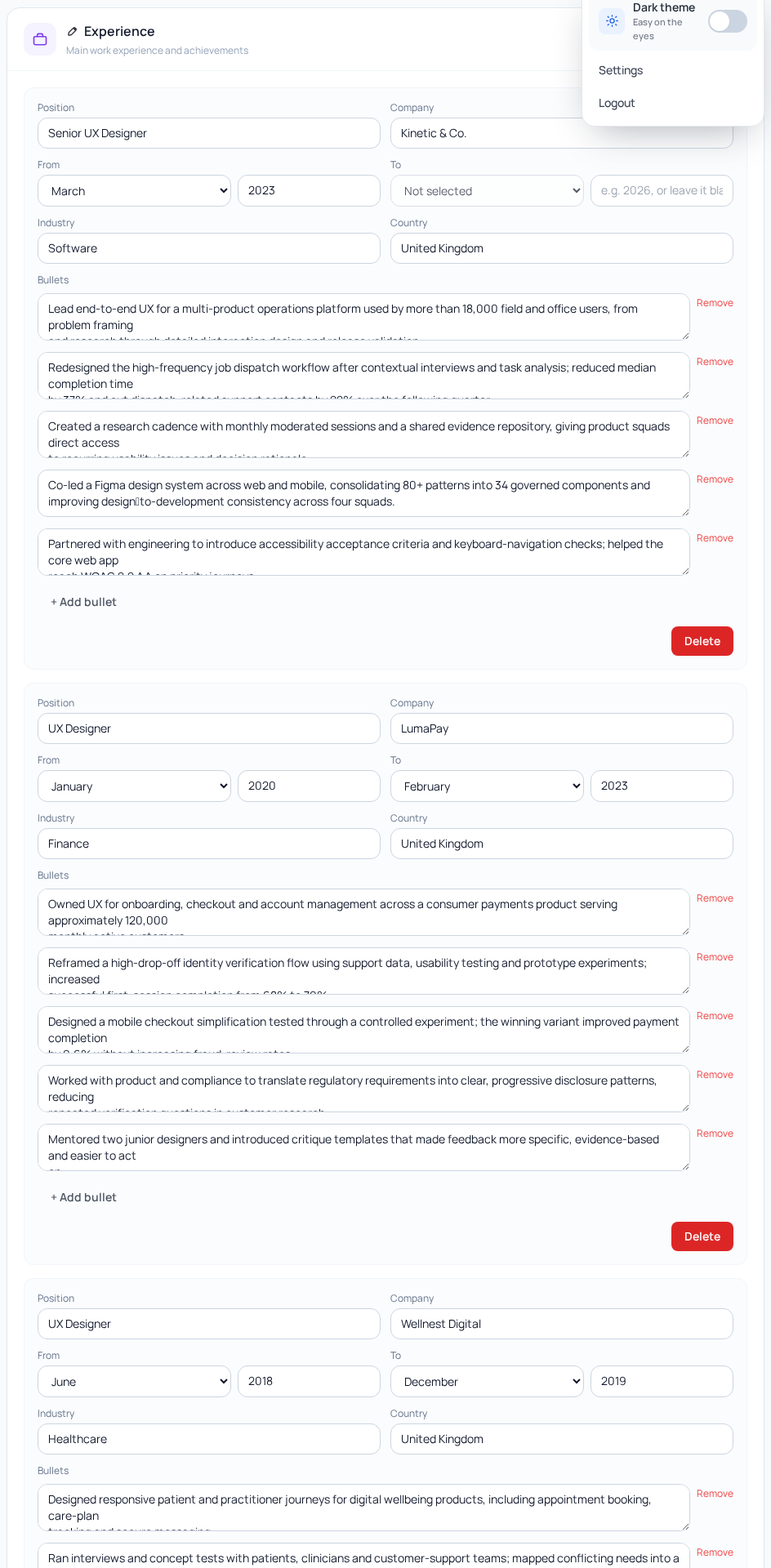
The best project entries are factual, compact, and easy to revisit months later. Record the dates, country, industry where relevant, a clear title or label, and enough context for the reader to understand why the project existed.
Then add bullets that show scope, tools, actions, and outcomes. CVZilla’s guidance is to describe real responsibilities, decisions, actions, tools, and outcomes, and to prefer concrete evidence over generic language. NACE makes the same point in its guidance on career journaling: if you wait until you need the CV, you are more likely to forget details and metrics.
For a high-tech CV, this matters because later tailoring should start from evidence, not memory. The practical habit is to write the project once as a factual record, then reuse it when you tailor for a new vacancy. That keeps the base stable and lowers the chance of overclaiming later. [inline banner placement candidate]
How olim and expats keep mixed histories readable
Cross-border careers often look messy on paper before they look impressive. If you are an oleh hadash or an expat, you may have projects across countries, work modes, or gaps that do not fit a neat linear employer timeline. Separate project records help by anchoring the chronology with dates and country.
This is also where transferable skills need a careful frame. O*NET’s Browse by Transferable Skills resource is useful because it reinforces the idea that some skills can move across different jobs, which helps when you are bridging markets or work styles. The key distinction is that transferable does not mean identical.
A practical example: if you completed two short contracts in different countries and also had a gap, the cleanest move is to keep those projects separate, with clear dates and context. That keeps the story readable for Israeli and European hiring teams, while preserving the difference between direct and adjacent experience.
What hiring teams need to scan quickly
Hiring teams in high-tech usually do not have time to untangle a crowded CV. They want to see what the project was, what your role was, when it ran, and what changed because of it.
That means the best project bullets usually lead with the problem, the action, the tools, and the result. It also means your project section should make delivery work easy to spot when standard employment history is too broad to show it clearly.
Broader hiring guidance supports that approach. National Careers Service says CVs should be tailored to the job and that gaps are normal, while NACE emphasizes that experiential learning and project-based work can be valid evidence of skills. One relevant, well-framed project is stronger than several vague lines.
How one factual profile makes tailoring faster and safer
CVZilla’s workflow is built around one maintained Profile: keep the facts accurate there, then tailor from a real vacancy and review the result before sending. That matters because project-heavy candidates often need to reuse the same evidence in slightly different ways.
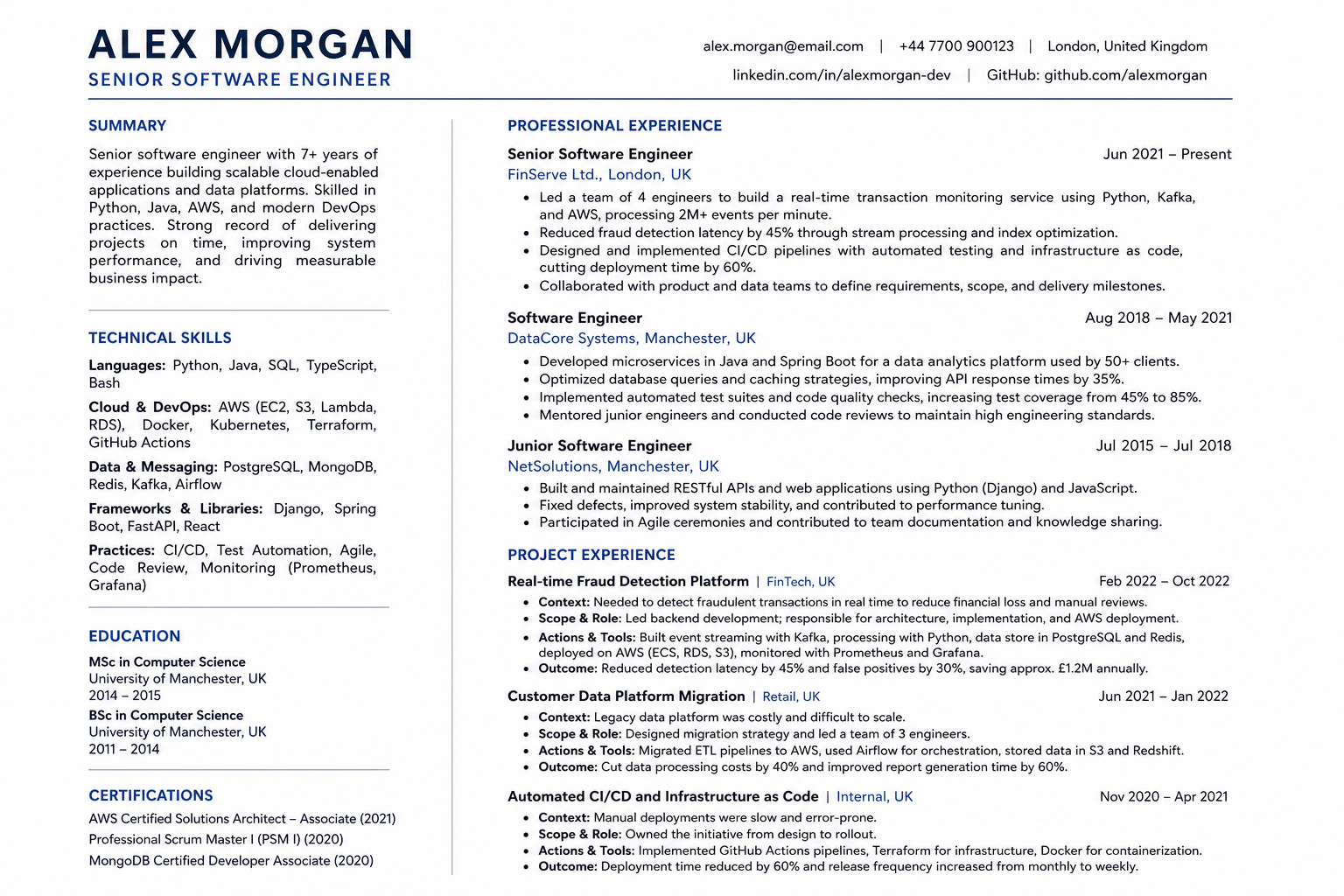
Experience and Projects are separate record cards, so you can preserve the factual base once and reuse it without starting over. That reduces rewriting, keeps dates and country details current, and makes it easier to adjust the emphasis for different roles.
The vacancy tells you what the role needs, but it does not grant permission to claim unsupported experience. Your task is to map existing evidence to the job. For mixed histories, that one-source approach keeps the chronology intact and gives you one truthful base to update instead of multiple files that drift apart. It also aligns with the simpler workflow described in Why One Profile Is Easier to Keep Current Than Multiple CV Files.
Project-heavy candidates do better when project experience has its own place. It keeps the timeline readable, makes delivery visible, and gives hiring teams the evidence they need without forcing everything into one employer line.
For olim, expats, consultants, engineers, and anyone with mixed work modes, the real advantage is continuity. A clean project record preserves dates, context, scope, and outcomes so the CV still makes sense when the career does not follow one straight path.
If you keep one factual profile current, tailoring gets easier instead of messier. That is the value of a maintained source: less rewriting, less overclaiming, and a stronger starting point for every application.